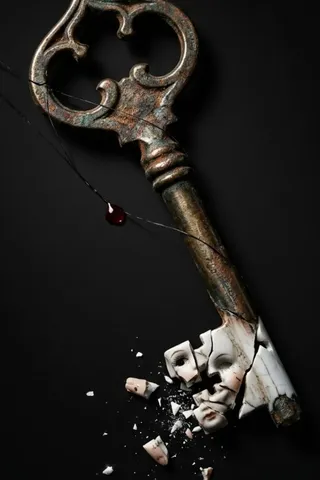
Chapter 45: The Patient Returns
Kestrel
My mother has lived for thirty-one years in a room with one clock, and it is wrong.
I see that before I see her. I stand in the doorway of a long, low, sunlit parlor on the second floor of a nursing home in Hudson, on the sixteenth of February, in my plain gray suit, with my hat in my hand, and my eyes go, as they have gone into every room since I was a child, to the nearest timepiece. It hangs above the mantel. A cheap quartz thing with a plastic face and a sweep hand. It says ten past three. My watch says twenty to four.
Twenty-nine minutes slow, I think.
She has not noticed.
She is sitting in a wing chair by the window with a shawl over her knees and a book open face down in her lap. The light falls on her from the side. She is smaller than I remember. She was a tall woman, once, with a straight back and a long jaw and gray eyes that would go through a wall; I remember her in a white coat, at the head of a table, with a pair of steel spectacles pushed up into her hair. The woman in the chair is bent. Her hair is the color of ash. Her hands, spotted and veined, lie quite still on the shawl.
She does not turn her head.
"You are late, Ambrose," she says.
I do not know how she knows.
"By twenty-nine minutes," I say.
"Your watch is fast. Mine is slow." She turns the page face down. "I find that at my age it makes very little difference."
…
I sit.
There is a second chair, a straight one, with a cane seat, pulled up opposite hers at the exact distance of a consulting room. Someone has put it there on purpose. I lower myself into it and lay my hat on my knee and look at her, and she looks at me, and for some time neither of us says anything at all.
The room is warm. It smells of lavender and boiled vegetables. Somewhere down the corridor a television is murmuring a game show. A woman in a pink cardigan goes past the door with a walking frame, slowly, nodding to herself.
"They tell me that I may have an hour," says my mother.
"I have the afternoon."
"Ah."
"I did not know where you were."
"No."
"I thought you were in Zurich."
"I was in Zurich. For twenty-two years." Her voice is dry, level, a little hoarse. It has lost the Austrian roll that I remember. "I worked in a clinic for the elderly, under the name of Gertrude Albers. I scrubbed floors for the first three. After that they let me do the books." A faint twist at the corner of her mouth. "I am a very competent bookkeeper. You would be surprised."
"I should not."
"It is the only thing I did well."
"That is not true."
"Isn't it?"
I do not answer.
"I came back in November," says my mother. "I had a letter from a solicitor. It said that a certain person was dead. That the file was therefore of no consequence." She lifts her eyes to mine. "I knew, of course, what it meant. Augustin was not dead. Augustin was dying. It was a message from Cordelia. She was telling me I was safe."
"And you were not."
"No." A pause. "I was never going to be safe again, Ambrose. I think I knew that. I think I have always known it. But I was seventy-two years old, and I had not seen my son's face for thirty-one years, and I thought that I should like to, before I was dead."
"Mother."
"I went to the gala."
I stare at her.
"Not in the ballroom. I haven't the clothes." The ghost of a smile. "I sat in a car across the road, with the radio on. They were playing it on the radio, you know, the whole of it. A man read it out. I heard your friend with the lantern tune. I heard the boy say his name." She closes her eyes. "And at seven the next morning, a woman reporter read out a list of the dead on the radio, in a clear voice, like a nurse. Callie Ashby. Bridget Sorrell. Dennis Oakhurst. And at the bottom, quite quickly, as an afterthought, a girl from the year 1994. Rosalind Kestrel."
I say nothing.
"I have not heard anyone say it aloud," says my mother, "for thirty-one years."
…
She takes a photograph from under the book.
I had not seen it. It was lying flat against the cloth of the chair, half hidden by her fingers, and when she lifts it, it is a small square print, curling at the corners, brown with age. She holds it out to me across the gap between our knees.
I take it.
It is a girl on a hill. She stands in a field of long grass with her face tilted up to the sun and her arms flung wide, in a white cotton dress that the wind has whipped against her legs. Her hair is down. It is black, and very long, and the wind has taken it and blown it out sideways like a flag. She is laughing. She has her mouth wide open, and one hand up to hold the sky.
On the back, in a hand I know, in blue ink: R., Wickhollow, June.
"I took it," says my mother, "the summer before. I kept it. In every place I lived. In a shoe, in a Bible, in the lining of a coat." Her fingers are trembling. "I looked at it every night. I looked at it until the face was worn off."
"It is not worn."
"No. I made a copy."
I look at the girl on the hill.
I think of a keyhole, and a rough whisper, and a pale blue orchard, drawn on a wall in chalk.
"You gave her the injection," I say.
It comes out quite gently. I had not meant to say it so soon. I had meant to wait: to sit for an hour, to take tea, to arrive by degrees at the thing. But I am a clinician, and I have the clinician's instinct for the thing in the room that nobody will name; and it is sitting between us on the carpet, patient, enormous, with its hands in its lap.
My mother does not flinch.
"Yes," she says.
"On the fourth of November."
"At twenty past eleven. In the Quiet Room." She meets my eyes. Hers are dry. "Cordelia stood behind me. She held the lamp. She did not say anything. She did not need to."
"Was it chloral?"
"It was chloral and morphia. In a spoon of syrup. I dissolved it myself." A breath. "I told myself that she would sleep. I told myself that when she woke she would not remember. I told myself that it was the kindest thing."
"Did you believe it?"
"No."
"Then why?"
"Because the alternative," says my mother, "was that I should have to ask what it meant that I had a daughter who had been hurt by a man who gave my hospital its boiler." Her voice is level. "I could not afford the question. I made myself into a person who could not ask it. I had been making myself into that person for some years."
"I see."
"It is not an excuse."
"No."
"It is merely what happened."
I put the photograph on my knee.
I sit with my hands flat on my thighs, and the sunlight on my sleeve, and a game show going on in the distance. I look at the old woman in the shawl. I try, with the whole of my training, to find the thing that I am supposed to feel. I search for rage. I find it, very far down, quite cold, like a stone at the bottom of a well. I search for grief. I find that, too. It is larger than I expected, and it does not move.
And beside them, in the same dark, quite small, I find something else.
I find that I am glad to see her.
I find that I would like, very much, to put out my hand.
…
"I am not here to forgive you," I say.
"No."
"I wish that to be clear."
"It is perfectly clear."
"I do not know whether I can. I do not know if it is a thing that I am able to do." I look at the photograph. "I suspect that I am not built for it. I was made to be a man who counts what is owed."
"I made you that."
"You did."
"I am sorry."
"Yes."
"It will not help."
"No."
She nods.
"But I am here," I say, "because someone ought to see you."
I look up.
She is crying.
It is very quiet. It does not distort her face. It runs down the lines of it, one on each side, and falls into the shawl, and she does nothing to stop it. She sits with her hands in her lap and her eyes on mine and weeps as a very old tree sheds water in a thaw: slowly, without sound, without apparent grief.
"Thank you," says my mother.
"Do not."
"I must."
"Then say it once."
"Thank you, Ambrose."
I take her hand.
It is small and dry and light as a leaf. I hold it in both of mine, on my knee, on top of the photograph, in the sun. We sit like that for a long time. A clock ticks on the mantel, twenty-nine minutes slow. And I think of what the girl in the letter said, about a frightened woman who made herself the only kind of person she knew how to be.
Don't be angry with her forever. It isn't worth it.
She'll punish herself far worse than you could.
She was right, I think.
She was right about everything.
…
The box arrives at Wickhollow on the first of March.
It is a gray cardboard box, the size of a hatbox, tied with a black ribbon and sealed with a bead of red wax. Marcus carries it in from the car with both hands, as one carries a thing that might go off, and sets it on the kitchen table. Elspeth is standing at the range with her back to me, stirring a pot. She does not turn.
"It's from Marrow Hall," she says.
"I see that."
"Cordelia's key. I told you."
"You did."
"I've read it."
I look at her shoulders.
She is wearing a gray sweater and an apron over it, with her sleeves pushed to the elbow. Her hair has grown. It is a dark soft cap now, curling at the nape, and I have found that I cannot look at it without wishing to put my hand there. The kitchen smells of onions and thyme. A kettle is warming. On the windowsill, among the geraniums, a small walnut clock is ticking.
"All of it?" I say.
"All of it. There's a file on your mother. There's a file on a boy called Ambrose Kestrel, aged ten, in the handwriting of a state trooper." She taps the wooden spoon on the rim. "There is a page of pencil on a sheet of lined paper. I'm not going to tell you what's on it."
"I know what is on it."
"Then you don't need me to."
"No."
"It's yours." She turns. "You can do what you like with it."
I untie the ribbon.
The wax cracks under my thumb. I lift the lid. And I see them, laid neatly one on top of another in a bed of tissue paper: the buff folder, tied with blue tape; a thin gray one, dog-eared; a bundle of letters. And on the top of it all, quite flat, folded once, a sheet of paper so old that it has gone brown at the edges and soft as cloth.
I take it out.
I unfold it.
The writing is large and careful, in pencil, in the round upright hand of a child who has been told to be exact. It is smudged in places. It has been folded and unfolded many times. There are four lines.
I went to the door of the quiet room. It was open. My mother was inside. A lady in a white coat was holding her arm. There was a needle.
I did not go in.
I wasn't supposed to be there.
I am sorry.
There it is. The page that has held me for thirty-one years.
It weighs nothing.
I stand in the kitchen at Wickhollow with the light coming through the window and the clock ticking on the sill, and I read it a second time. And a third. And then, quite calmly, without ceremony, I cross the floor to the stove, and lift the lid, and lay it on the coals.
The paper curls. It blackens at the edge. A thread of flame runs up it, small and bright and yellow, and for a moment I see the words stand out in the fire in clean white lines, as a negative stands out, before they go.
I am sorry.
It is gone.
I put the lid down.
"There," says Elspeth, quietly, at my shoulder. "You were ten."
"Yes."
"You weren't supposed to be there."
"No."
"It wasn't your fault."
"I know," I say. "I have always known." I stand with my hand on the cold iron. "It is merely that I have never before been told so by a person who meant it."
She puts her hand on my back.
…
I have a house.
I have not said so, because it did not seem worth the saying. It is the house on the hill, and I have lived in it, with some interruption, for six weeks. It is a plain gray farmhouse with a leaking roof and a very old range, and I have learned to light the stove. I have learned that the kettle must be filled before it is set to boil. I have learned that if you open the west window at dawn you can hear a woodpecker in the apple tree.
I have my clocks.
Marcus brought them from Aldenmoor in a hired van, one at a time, wrapped in blankets: the seven pendulums, the brass chime, the long-case from the study. They stand in the front room now, in a line along the wall, ticking in seven different time zones. I wound them myself. I set them to the second. They keep very good time, except for the one from Zurich, which gained a minute in the move, and which I have decided to leave.
I have no patients.
I have no license, no practice, no couch. I have a bank account, in a name that is not Marrow, which a woman called Castellane has told me is in no way connected to the Foundation. I have a small pension from a fund I do not understand. I have a great deal of time.
And I have, three nights in seven, a visitor.
…
She comes on Fridays.
She comes up the lane at dusk in the long gray car, with her bag over her shoulder, and Marcus sets her down at the door and drives away. She does not knock. She lets herself in with a key I have given her, and hangs her coat on the nail by the door, and goes straight to the kitchen to see what I have burned.
She sits with me while I eat.
She tells me about her week. The inventories. The lawyers. The long cold grind of probate, which she attacks with a ferocity that Miriam describes as indecent. The Foundation, whose assets she is dismantling one by one, with a pencil, in the evenings, in an office at Marrow Hall that used to be a dairy. Callie Ashby, whose body has been found. Twelve days ago, under a flagstone in the old laundry at Aldenmoor, in a trunk, wrapped in a blanket. Mrs. Ruth Ashby has flown to New York. She is staying in a hotel on Lexington. She has been twice to the grave. She told me, says Elspeth, that the porch light can go out now.
I listen.
And when the plates are cleared, and the kettle has been set to boil, and she has leaned back in her chair with her bare feet on the rung of mine, she looks at me, and says, in the soft level voice that I have learned to dread:
"Have you slept?"
"No."
"At all?"
"A little. Between four and five."
"On the chaise?"
"On the kitchen floor."
"Ambrose."
"I did not wish to disturb the cat."
"You don't have a cat."
"I am thinking of acquiring one."
She doesn't smile.
"Six nights," she says.
"Seven."
"You count them."
"I count everything."
"I know." She takes her feet down. "Come here."
I go.
I kneel in front of her chair, on the stone floor, in my plain gray suit, and she takes my face between her two hands. They are cool and dry. She holds it quite still. And I look into her eyes, large and dark and grave, and I see her looking back; and I understand, with perfect clarity, that this is the thing I have been waiting for all week.
"Glass Orchard," says Elspeth.
I go under.
…
It is not as it was.
There is no chaise, no lamp, no watch on a chain. There is only the kitchen table and a window with a black square in it, and a clock on the sill, and a woman's voice. It comes from a long way off. It says: you are very tired. It says: you may put it down. It says: I have got you.
I sleep in the chair.
I sleep for eleven hours with my head on her knee and her hand in my hair, in the stone-flagged kitchen of my mother's house, and I do not dream. I wake at a quarter past eight on a gray March morning with a crick in my neck and a rug over my shoulders, and the smell of coffee, and the sun on the geraniums. I lie there. I look at the cracked ceiling. I listen to the clocks.
And I think, with absolute calm:
I am a man who cannot sleep unless she wills it.
I am a man who has not slept for six days because she was not here.
I am a man who counts the hours to Friday.
I think of a girl in a letter. Go to sleep.
I think of a woman in a green gown, in a ballroom, saying to a man who had asked for forgiveness: You get to carry it.
And I find, rather to my surprise, that I do not mind.
…
On the twenty-first of March, I lock myself in.
I do it of my own accord. It is a Saturday, in the early evening, in the first real warmth of the year, with the snow gone from the lane and the apple tree beginning to bud. She is not there. She will not be there until Friday. She has gone to Albany for the sentencing of Warren Marrow, who has been given forty years, and who received it, she said on the telephone, with a faint inclination of the head, as a man receives a bill.
I go down to the cellar.
It was Marcus who found it. A door behind the coal bin, bricked over in my mother's day, which gave onto a low vaulted chamber of whitewashed stone, ten feet by twelve, cool and dry and perfectly silent. I had thought it a root cellar. It is not. It is a room that was built, in 1810, for a purpose long forgotten, by a Dutchman who valued his privacy.
There is a bed in it now. A narrow iron one, with a white coverlet.
There is a lamp, with a green shade.
There is a shelf with a dozen books on it, and on the wall above the bed, in blue chalk, copied by a careful hand from a drawing in an attic, a row of glass trees.
I stand in the door.
I look at it for a long time. The lamp is lit. The chalk apples glow. On the pillow there is a folded sheet of notepaper, and when I pick it up I see that it is in her hand, in neat block capitals, like a clerk's.
YOU DON'T HAVE TO. — E.
I put it in my pocket.
I step into the room.
The door is oak, ironbound, with a heavy lock on the inside and a key in it, a long black key with a bow like a clover. I take hold of it. I turn it, slowly, in the cold oiled mechanism, and I hear the bolt shoot home, with a small, deep, definitive sound, like a word said once.
I stand with my back to the door.
I am in a white room, with a lamp, and a bed, and a chalk orchard on the wall. I am a man of forty-one who has locked himself in. And for the first time since I was ten years old, I feel no urge at all to be anywhere else.
I draw the key out of the lock.
I look at it, in my palm, in the lamplight.
Then I kneel, and slide it under the door, along the stone floor, out into the dark of the passage, where she will find it on Friday.