Chapter 44: The Matriarch
Elspeth
She does not fight them.
That is what everyone says afterward, in the corridors, in the newspapers, in the long soft murmur of the courthouse lunch hour: that she did not fight. They had expected a lioness. A woman who had broken senators, who had buried three governors, who had sat at the head of a table for forty years and never once raised her voice. They had expected her to stand up in the dock, in black silk, with her pearls and her cameo and her little straight back, and tell the court of the State of New York precisely where it might put its indictment.
She sits.
She sits on the twenty-sixth of January, in the arraignment part, in a plain gray suit that someone else has chosen, with her hands in her lap and her silver hair, for the first time in anyone's memory, slightly untidy. She hears the clerk read the counts. Conspiracy in the second degree. Obstruction of justice. Tampering with evidence. Hindering prosecution. Criminal facilitation of murder. She hears her lawyer, a young man from Warren's old firm who has come to the courthouse in a taxi and looks as though he would give a month's salary to be elsewhere, say that his client pleads not guilty.
"No," says Cordelia.
The room stills.
"I beg your pardon, Mrs. Marrow?"
"I do not plead not guilty." She says it in her small dry carrying voice, without raising her eyes. "I should like to withdraw that. It is untrue. I should like to say what is true."
"Mrs. Marrow—" says the lawyer.
"Sit down, Mr. Kemp. You have been very kind."
He sits.
"The facts," says Cordelia, "are as my son stated them. In substance. I should say that he was imprecise on one or two points of timing. But he did not exaggerate." She lifts her head. Her pale eyes travel across the bench and the flag and the gallery, and stop at the third row, and at the thin woman in the green coat. "I am guilty, Your Honor. I should be glad to be sentenced at the earliest opportunity."
Then she folds her hands again.
And she does not speak another word, to anyone, for nine days.
…
They send her to Aldenmoor.
It is an irony, and a cruel one, and I do not think anyone intends it. The court orders a psychiatric evaluation. The Department of Mental Hygiene names the nearest secure facility with available beds. The nearest is a gray stone pile on a hill above the Hudson, under the receivership of the State of New York, with its east wing gutted, its medical director gone and its roof half-covered in blue tarpaulin; and there, on the evening of the second of February, in a state ambulance, with a nurse on either side of her, a small old woman in a gray coat is carried up the drive between the beeches, through the snow, to the foot of the very steps where I once stood in a white hospital gown.
I am there when she arrives.
I tell myself that I have no particular reason. It is part of my duty as the executrix of an estate. I have papers to sign; there are Foundation assets in the building that must be inventoried. I stand in the hall, in the navy coat and the gray mittens, with a clipboard, by the long window that gives onto the drive. And I watch the ambulance come.
She is helped out. She stands for a moment in the snow with the nurses' hands under her elbows, looking at the house.
She looks at the roof. She looks at the black ruin of the east wing, where the boiler house was, and the pile of charred beams. She looks at the beeches. She looks at the great front door, the carved lintel, the plain brass bell. Her face is quite expressionless. She might be a woman waiting for a train.
Then her eyes lift to the window.
To me.
She does not smile. She does not nod. She regards me through the glass, across forty yards of snow, for the length of a long breath. And I, who have stood in front of this woman for eight years and never once been seen, stand quite still and let her.
It is Cordelia who looks away first.
…
I find her in the west wing, on the third day.
It is a long white room with a high ceiling, a window on the garden, and a bed with a gray blanket. Someone has put a chair in it. Someone has put a vase of snowdrops on the sill, which I know to be Mrs. Pell, the silent woman in the gray apron, who has stayed on without pay and without explanation because, she said, to the receiver, in the only sentence anyone has ever heard her say, someone ought to. A radiator ticks. The light is pale and level.
Cordelia is sitting in the chair.
She has a rug over her knees. She has her hands folded. Her hair has been brushed and pinned by a stranger's fingers, a little too tightly, and her face, without its powder, is smaller and yellower than I remember. The lines in it are very deep. She looks like a very old, very fine piece of paper that has been folded and unfolded too many times.
"Mrs. Marrow," I say.
She turns her head.
"I'm told you haven't been speaking."
She says nothing.
"I wondered if that was a choice."
A long silence. Then, very slowly, in a thread of a voice, dry as a leaf: "I find I have nothing to say that could be improved by saying it."
"That sounds like you."
"Does it?"
"Yes."
"Good." Her eyes go to the window. "I was afraid I might have lost the knack."
I cross the floor. I sit in the second chair, which has been placed opposite hers, at the exact distance one would arrange for a visit in a drawing room. I fold my hands. I look at her. She looks at the snowdrops.
"May I ask you something?" I say.
"You may ask."
"Why did you plead?"
"Because it was true."
"That has never stopped you."
A faint movement at the corner of her mouth. It is nearly a smile. "No. It has not."
"Then why?"
She is silent a long time.
"My son stood on a stage," says Cordelia at last, "and said it. In a clear voice. In front of everyone he knew. He said it without notes." Her fingers move on the rug. "I have never seen him do anything without notes. I thought: so that is what he was for."
"Conrad."
"Yes."
"You thought he was weak."
"I thought he was mine," says Cordelia. "It is a different thing. I thought that I had made him. I thought, God forgive me, that whatever was in him, it was something I had put there." She looks at her hands. "I was a fool. I made a mask. And behind it there was a boy who got up."
She stops.
Her lips tremble, once.
"He said that, didn't he?" she says. "On the terrace. Before he... They told me. A young detective. He said that my son said, Tell Mother I got up."
"Yes."
"Was it true?"
"I think so."
"Did he mean it for me?"
I consider.
"I think," I say, "he meant it for himself. I think he wanted you to know."
Cordelia closes her eyes.
…
She asks me then if I am afraid of her.
It is an odd question. It comes out of nowhere, as the sun comes out of a cloud, after a long pause in which I have sat watching the snow slide off the roof of the wing. She says it with her eyes shut, in a voice so low I have to lean toward her to hear.
"Are you afraid of me?"
"No."
"You were."
"Yes."
"When?"
"At the foot of a marble staircase," I say. "Eight years ago. When you looked at me."
"Ah." She opens her eyes. "I remember."
"Do you?"
"A girl in a green velvet dress. With a pen in her glove." She lifts her chin. "I thought: there is a person who counts. I thought it was a dreadful pity. I thought that if I were a better woman, I should have told Conrad to marry someone stupid."
"You didn't."
"I did not. I thought, she will be useful. She will keep him tidy." The pale eyes rest on me. "I was right. You did. You kept him so tidy that he put you in a quarry."
I do not speak.
"I am going to tell you something now," says Cordelia, "and I want you to understand that it is not an apology."
"I understand."
"I have never apologized in my life. It would be vulgar to start." She draws a breath. "But I should like you to know that on the night of the fourteenth of October, I was in my library, at Marrow Hall. I was drinking a glass of sherry. At nine o'clock, Warren rang. He said: 'It's done.' I said: 'And the girl?' He said, 'She's in the car.' And I said: 'Then take her somewhere quiet.'"
My hands are very still.
"I did not say kill her," says Cordelia. "I want that clear. I thought of it. For some hours. I sat with the glass and I weighed it. I have weighed such things before. But I looked at the figures, and I thought: No. She has been useful. She will be useful still. I thought that a woman who has been erased can be written on."
"You wanted me to be a puppet."
"I wanted you to be quiet." She says the word with a bitter precision. "That is all any of us ever wanted. A quiet girl. A quiet boy. A quiet nurse. A quiet house. I think I have spent my whole life asking people to be quiet." Her mouth twists. "And it seems that in the end the only ones who listened were the dead."
…
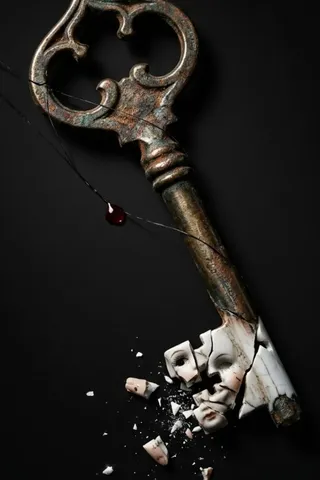
She gives me the key an hour later.
I do not ask for it. She takes it from the pocket of the gray coat which is hanging on the back of the door, and holds it out to me across the space between us, on her flat palm, a small brass thing on a loop of black ribbon. It is warm from her body. I look at it.
"My library," says Cordelia. "At Marrow Hall. The tall case, on the east wall, behind the Gibbon. There is a panel."
"A safe."
"A steel box. In it you will find a number of documents." She does not look at me. "Some are of no importance. Some are of the very greatest. There is a file in a buff folder, tied with blue tape. There is a larger one, in a gray box, which concerns the late Dr. Margarethe Kestrel."
"She's not dead."
A pause.
"No," says Cordelia. "No, I suppose she is not."
I stare at her.
"You didn't know."
"I was told she had gone to Switzerland. Twenty-five years ago." A flicker. "I paid the nursing home for her first three years. And then there was a letter from the Swiss. I assumed." She looks down. "I did not inquire. It was convenient."
"She was in the front row at the Office of Discipline."
"Was she?"
"In a black hat."
"How like her." Cordelia's lips twitch. "She always did know how to make an entrance." She is silent a moment. "Ambrose told me that. At the gala. On the stairs. I could not make out what he meant."
"What did he say?"
"He leaned down," says Cordelia, "and put his mouth to my ear. And he said: It is finished. My mother has talked."
…
I did not know about that.
I sit with the brass key in my hand, in the white room, with the snowdrops on the sill, and I turn it over.
My mother has talked.
I think of a tall gray man in a black half-mask at the foot of a staircase, with a hand on a small old woman's arm. I think of the brief, dreadful alteration in Cordelia's face, which I saw across the ballroom and did not understand. A leash had been cut. A sealed statement, held for thirty-one years in a safe, which had made a man into a servant; and a woman, a seventy-year-old woman, whom nobody had known to be alive, had walked into Miriam Castellane's office on the morning of the fourth of January, in a black coat, with a veil, and said: I should like to give evidence. I believe it will be of some interest.
She did it for him, I think.
She did it so that he could have the page.
"Ambrose never told me," I say.
"Did he not?"
"No."
"Then I should think he was ashamed." Cordelia's voice is dry. "It is a thing that a son feels. To have been forgiven. By someone he'd been taught to despise."
I look up.
"Is that why you're giving me this?"
"I am giving you that," says Cordelia, "because there is a girl's death in the second box. And it belongs to him." She nods at the key. "I should like him to have it. I do not expect he will thank me."
"No."
"I am old," she says. "I am a very old woman, in a very plain room. I am going to die in this building. I should like it to be known that I had the grace, at the end, to put a few things in order."
"It isn't grace."
"No?"
"It's an audit," I say.
She looks at me.
For a moment her face is entirely still. Then, slowly, with a kind of terrible delicacy, as a crack runs across a pane of ice, she smiles.
It is a real smile. It is the first I have ever seen on her. It transforms the whole face: draws it up, lights it, makes of it for an instant the face of a beautiful young woman who has just been told something very funny. She laughs. It is a small, dry, helpless, astonished sound, like a bird that has flown into a room.
"Oh," says Cordelia Marrow. "Oh, my dear. Yes."
…
I stand to go.
I put the key in my pocket. I smooth the front of my coat. At the door I stop, with my hand on the frame, and I turn.
She is sitting in the chair by the window, with the pale light on her hair, small and upright and alone. The snowdrops are white against the glass. In the corridor behind me, I hear Mrs. Pell's slow heavy tread, and the rattle of a tea-trolley.
"Mrs. Marrow."
"Yes?"
"I'm not going to forgive you."
"I did not suppose you would."
"I wanted you to hear it."
"I have heard it." She inclines her head. "Thank you. It is a courtesy."
"There'll be a trial."
"Of course."
"I'll be at it."
"I should hope so." Her eyes rest on mine, pale and level. "Elspeth."
"Yes?"
"Is there anyone at home?"
I stand there.
I think of a green room, and a gray chair, and a voice behind my left shoulder. I think of a girl with cropped black hair, who ate her toast and said ma'am and counted the slats in a bed. I think of forty-one repetitions, and a man asleep in my lap.
"Yes," I say. "There always was."
"Good," says Cordelia. "It is a great mercy. I never had one."
I go out.
I close the door softly behind me. I go down the corridor, past the nurses' station, past the long window, down the stairs to the front hall; and I walk out of the doors of Aldenmoor Sanatorium, into the hard white light of a February afternoon, and I do not look back at the house.
At the foot of the steps a long gray car is waiting, with its engine running. A man in a gray coat holds the door.
"Where to, madam?" says Marcus.
"Marrow Hall," I say.
I get in.
And as the car turns down the drive, between the beeches, with the snow falling softly from the branches, I take out of my pocket a small brass key on a loop of black ribbon, and hold it in my glove, and look at it, and think, quite calmly, with no triumph and no pity: it is eleven miles.
I will be there by four.