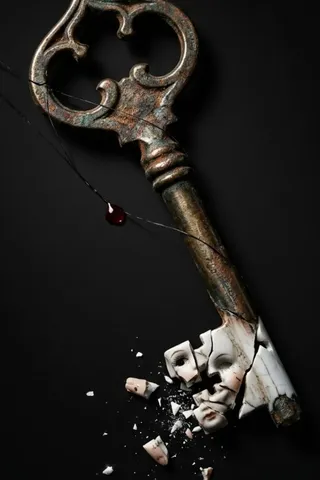
Chapter 38: A Defensible Outcome
He woke to the smell of antiseptic and the sound of someone breathing, and for a long, soft, drifting minute, Anselm Varga did not know which of his lives he was in.
The ceiling was white. A tube ran into his left arm. His right shoulder was packed in something thick and tight that throbbed in time with his pulse, like a second, slower heart. Gray light came in at the window, and in it hung a single bar of dust, turning. He lay and looked at it, and thought, with perfect lucidity: I've been shot twice. I'm thirty-eight. I seem to have a talent for it.
Then he turned his head.
She was asleep in the chair.
She sat in the visitor's armchair with her feet drawn up under her and a hospital blanket pulled round her shoulders, her cheek on her fist and her hair coming out of its pins. Both her hands were wrapped to the wrist in white gauze. She had no shoes on. The navy suit was gone; she wore a gray sweatshirt that said Lutheran Medical Center Auxiliary, and there was a smear of dried blood on the cuff that was not hers.
It was the same hospital. The same floor, almost. He'd been put, with a sort of grim comedy, in the same room.
He lay still, so as not to wake her, and watched her sleep.
She slept as she did everything, with total commitment. Her face was slack and young, her lips a little apart, one eyebrow drawn very slightly down as if she were arguing in a dream. There were violet shadows under her eyes and a cut at the corner of her mouth that had never entirely healed since May. He counted the breaths. He lost count at forty. He found that he did not mind.
She threw the bag, he thought.
It came back to him in pieces. The red light. The glass. A woman on the floor of a steel office, with the whole weight of the room against her, who had looked up at a man with a gun and, without waiting to be rescued, done something about it.
She didn't wait to be asked.
He began, very quietly, to laugh.
It hurt. It hurt abominably. He stopped, wincing, and the chair creaked, and her eyes opened, wide and gray and unfocused, and met his.
"You're awake," she said.
"So I'm told."
"You're not supposed to laugh. The doctor said."
"The doctor wasn't there."
"I was." She sat up, wincing at her hands. "I threw a bag at him."
"I noticed."
"I threw it very badly."
"It was the best throw I've ever seen."
"It hit his wrist."
"It hit his wrist." He found that tears were running down the sides of his face into his ears, and did not know why. "Linnea. You saved my life."
"You were shot in the shoulder."
"You saved it twice."
She stared at him. Then her mouth began to shake. She put the back of one bandaged wrist against it, and sat there, hunched in her blanket, laughing and crying, with her hair in her eyes, and he lay back on the pillow and let himself be happy, wholly and recklessly, for the length of one slow breath.
…
Perry Lindqvist came at ten, in a clean tie.
He seemed to have slept. He wore a pressed suit and polished shoes and carried a briefcase, and he stood in the door of the hospital room with his hair brushed flat and a look of nervous formality, like a man arriving at a christening. He nodded to Linnea. He nodded to Anselm. He did not sit down.
"Mr. Varga."
"Mr. Lindqvist."
"You'll want to know where things stand."
"I would."
"Hollis Brannock was arraigned at seven this morning before a magistrate in Newark on charges of conspiracy to commit murder, murder in aid of racketeering, kidnapping, and obstruction of justice. Bail was denied. He didn't ask for it." The prosecutor set the case on the foot of the bed. "He requested tea. The magistrate said he would see what could be arranged."
"That sounds like him."
"The recording is perfect. Both of them are, actually. We have the main card, from Mrs. Varga's coat, and a corroborating file from the pen that Tolliver pulled this morning. The jammer killed the pen's feed at eleven forty, but there was a thirty-second buffer. Everything he said about Istvan Varga went onto the card before the jammer came on." A pause. "I have never in my life had a clearer confession. I could read it to a jury in an hour and they'd convict before lunch."
Linnea let out a breath.
"And Wick?"
"Wick is being very informative. Wick, as it turns out, has strong views about the proper conduct of a hearing, and has been explaining to my paralegal for the past three hours why a defendant in his position is entitled to a Rule 11 colloquy." A faint, weary smile. "He's told us where the Hale evidence is. A locker in Hoboken. I don't expect it will be a surprise."
"And Ruddick?"
The prosecutor's smile faded.
"Mr. Ruddick," he said, "walked into the lobby of this hospital at six this morning."
Anselm went still.
"He came in through the front door, in a dark coat, carrying nothing. He asked the desk clerk where he could find an agent of the FBI. He was told to sit. He sat. He has been sitting in a chair in a room on the first floor for four hours, with a cup of coffee he hasn't touched, and a drawing." Lindqvist's mouth twisted. "A child's drawing. A girl's. A horse. He won't let it out of his hand."
"Maeve," said Linnea softly.
"I thought you'd know."
"He's in a room here?"
"He asked to be." The prosecutor looked at Anselm. "He said he wished to make a statement. He said he wished to make it in a place where he could be seen by the man he'd betrayed. I don't think he knows what he's asking. But I thought you should be told."
…
They took him down in a wheelchair.
He had insisted. The nurse had said no, and the doctor had said no, and Linnea had said, very quietly, Anselm, and he had said, Please, and something in the way he said it had made the whole room go still. He was wheeled through the long, bright, ugly corridors of the first floor with a drip on a pole beside him and a gray blanket on his knees, past a vending machine, a wall of get-well cards, an old woman asleep in a chair. At the end of the passage was a plain door with a small square window. A guard stood beside it.
He looked through the glass.
It was a small room. A table, three chairs, a steel waste-basket. And at the table, with his big hands lying flat in front of him and his head bowed, sat Cormac Ruddick.
He looked small.
That was what Anselm would remember. For eighteen years he had known the man as a kind of architecture: a doorframe, a wall, a thing one leaned on without looking. Now he saw a heavy, aging, rumpled figure in a dark coat that had been slept in, with gray stubble and a ruined, swollen, patient face. On the table, between the hands, lay a sheet of lined paper. A child's crayon drawing. A blue horse with a purple mane.
"I'd like to go in," said Anselm.
"Sir, I can't—"
"Special Agent Tolliver has authorized it." Stahl had materialized at the end of the corridor, silent as a cat, an umbrella over his arm. "I took the liberty."
The guard hesitated. He opened the door.
…
Ruddick did not look up at once.
When he did, it was slowly, as if his head were very heavy. His eyes were red and dry. He took in the wheelchair, the drip, the bandage, the pale set face. His mouth worked. He rose, with an effort, to his feet, and stood there swaying, a very large man at attention.
"Mr. Varga," he said.
"Cormac."
"You're hurt."
"A little."
"It was the shoulder."
"Yes."
"I'd have stopped him if I could." The voice was a croak. "I was at the gate. They told me to wait with the car. I could hear it going, up at the warehouse, the shooting. I was going to run in. I swear to God, sir, I got as far as the fence." His hands opened and closed. "And then I saw her come out on the dock. With the blanket. Mrs. Varga. And I knew it was done. And I knew what I was. And I walked into the yards, and I just kept walking."
"Where did you go?"
"The chapel." A broken laugh. "At Memorial. Where Maeve's ward is. It's open all night. I sat in the back for four hours." His eyes filled. "I've not been in a church since my wife died."
Anselm said nothing.
He sat in the wheelchair in a plain white room and looked at the man in front of him, and thought of a grave. A cold October morning, the first anniversary he had been old enough to attend alone, a young man of twenty with a counter in his coat pocket. A large red-faced stranger in an ill-fitting suit, hired the week before as a driver, who had followed him up the hill uninvited and stood very close, so that his shoulder was against the young man's, saying nothing. Saying nothing for two hours.
He was twenty-six, he thought.
He was just out of the Navy. He didn't know what to say. So he stood there.
"Sit down, Cormac," he said.
Ruddick sat.
"Tell me."
"I can't."
"Tell me anyway."
"Sir—"
"Count honestly. It's the only way we'll get through it."
Ruddick put his face in his hands.
He told it. Not in a rush. In a flat, slow, halting voice, with long pauses in which he looked at his knuckles. The markers. The first call, four years ago, from a man with a soft voice who said he'd heard Cormac had some difficulties. The first small favor, a camera schedule. The second, a name. The way it had grown, year by year, the way a stain grows on plaster: no single day when the wall was ruined, only a morning when you looked up and saw that it was. Maeve's diagnosis. The envelope on the kitchen table. The soft voice saying, We'd be so glad to help.
"I told myself it was only information," he said. "I told myself nobody got hurt."
"And Pell?"
A silence.
"I didn't know about Pell," whispered Ruddick. "I swear, sir. Not until after. I told them the van was coming. I told them Corso had gone for coffee. That's all." His whole face crumpled. "That's all it was. A minute."
"And the night in May?"
"I opened the gate." It came out almost soundless. "I unlocked it from inside. I took the battery out of Dunne's radio. I told them the car would be at the corner at six-ten. And then I went upstairs to my room, and I sat on the bed, and I said the rosary. All of it. The whole thing." A tear ran down the side of his nose. "And the next morning I came down and made your coffee."
The room was very quiet.
Anselm looked at the drawing on the table. A blue horse. A purple mane. A sun in the corner with a smiling face. He had paid, three months ago, for a thousand days of that child's life. He had done it without being asked. He had done it, he supposed, to be forgiven, and found, to his private astonishment, that the forgiveness had not been the point.
"Cormac," he said.
"Sir."
"I said once that I would try."
"I know."
"I'm trying." His voice shook. "I'm not there yet. I'd be lying if I said I was. I think about what I'd do to you, if you were anyone else. But I stood in a garage in July and asked you to tell me, and you couldn't, and tonight you walked into this building and told me anyway." He drew a ragged breath. "That's a difference. It may be the only one that matters."
Ruddick lifted his head.
"I'll give them everything," he said. "The gate, the codes, the cameras. Every call. I'll stand up in any court they like." His lips trembled. "It's not much. I only knew the small things. I never knew where the big ones were buried."
"It's enough."
"Is it?"
"It's a witness." Anselm reached out his good hand, and laid it, for the first time in eighteen years, on the big man's wrist. "It's a man who tells the truth. I'd say it's the most we're given."
Ruddick bowed his head until it nearly touched the table, and the huge shoulders shook.
…
Judith Aldrich was waiting in the corridor.
She stood by the window at the end of the passage in a gray wool coat, a small straight silver figure with a briefcase at her feet, looking out at the parking lot. She turned at the sound of the wheelchair. She looked at Anselm, and at the drip, and at Linnea, who had come down behind him in her bandaged hands and her borrowed sweatshirt.
"Mr. Varga," she said. "I am told that you require counsel."
He stared at her.
"I have been in practice for forty years. I have represented two senators, a cardinal, and a man who tried to sell the Brooklyn Bridge to a tourist from Ohio." Her voice was dry and exact. "I have never in that time taken on a client I was sure to dislike. I have decided to make an exception."
"Judith," said Linnea faintly.
"Don't speak. You are not my client's counsel. You are his wife." The pale eyes were fierce. "You will sit in the gallery and look decorative, and when I want your opinion I shall ask for it."
"I'd be glad to."
"I doubt that very much." Judith turned to Anselm. "Mr. Varga. Perry Lindqvist has told me what he wants. I have told him what I want. We have, as it happens, a good deal in common."
"What does he want?"
"A guilty plea."
Anselm nodded slowly.
"On two counts of willful violation of a federal safety standard resulting in the death of an employee. Title Twenty-nine, Section Six-sixty-six. A misdemeanor. Six months each." She said it flatly. "And one count of corruptly influencing a federal proceeding. You'll know the one."
"Count Four."
"Count Four." A faint inclination of the head. "The government will recommend concurrent sentences, a total of twelve months and a day, to begin after the Brannock trial concludes. The entities, Ostrander Maritime Group and its affiliates, will plead as corporations and pay the maximum fine. All beneficial ownership will be forfeited. Every asset not required to satisfy that fine goes into a restricted trust for the families of the dead."
"The Calder Trust," said Linnea.
They all looked at her.
"I set it up on Monday," she said. Her voice was small, but quite steady. "With Stahl. I thought—if it came to it. There's a trust deed. There are three trustees. Marisol Ortega and Marcus Bell's widow and my father, when he's out. It's called after—" She stopped. "It's called after him because it was the only name I could think of that no one on the docks would put in the paper."
A silence.
"It's a good name," said Anselm.
"It's a bad idea. It means my father will be a trustee while serving a federal sentence."
"Your father," said Judith Aldrich, "has been a trustee of worse." She glanced at her watch. "I'll say one thing more. What Mr. Lindqvist is offering is more than I would have thought he could get. But it has a condition, and the condition is not mine."
"What is it?"
"The pages."
Linnea went still.
"The twenty-nine leaves." Judith looked at her with a level, unreadable gaze. "He will dismiss his motion to compel, with prejudice, if you swear, in an affidavit, that they have been placed permanently beyond the reach of any court. Not produced. Not destroyed. Placed. I shall not ask where." Her mouth thinned. "I have already told him that I would not be told. And I don't think you will tell me either."
"No," said Linnea.
"Good." The old woman nodded. "Then you may sign."
…
It was evening before they were alone.
The light had gone orange in the window. A trolley rattled in the corridor, and a radio somewhere played a slow song with a saxophone in it. He lay propped on three pillows, with the drip taped to his arm and his shoulder aching in a dull unceasing rhythm, and she sat on the edge of the bed, her bandaged hand in his good one, looking at nothing.
"You signed it," he said.
"I signed."
"The affidavit."
"Yes."
"Linnea." He tightened his fingers. "I have to ask. I will only ask once."
"Ask."
"The pages. Where are they?"
She did not answer at once.
She sat with her head turned toward the window, and the orange light fell across her face, across the bruise at her jaw and the cut at her mouth and the strand of dark hair that had come down across her cheek. She looked like a girl on a courthouse step, and like a woman of forty, and like neither.
"I can't tell you," she said.
"Because you burned them."
She said nothing.
"You must have." He heard his voice go thin. "It's the only way that signature is truthful. 'Placed permanently beyond the reach of any court.' You'd never have sworn it otherwise. You'd have had to destroy them, and you did, and you did it for me." He swallowed. "You chose me over your law."
She turned her head.
"No," said Linnea.
"You're a lawyer. You took an oath. And you—"
"I chose," she said, "the outcome I can defend in court."
He stared at her.
It was said very quietly, in a level, lucid voice, the voice of a woman reading a holding. There was no apology in it, and no triumph. She looked straight into his eyes, and the corner of her mouth moved, very slightly.
"I took an oath to the Constitution of the United States," she said. "I did not take an oath to a notebook. I swore to uphold the law, and the law, when you read it honestly, does not say a woman must hand her husband to a prosecutor if there is another way to put the man who killed his father in prison. It says that she must be honest. And I was. I told Lindqvist exactly what I was doing. I logged it. I filed it. I wrote a forty-one page brief. If he'd wished to challenge me, he could have, and I'd have argued it to the Supreme Court." Her hand tightened. "I did not conceal. I placed."
"You haven't answered me."
"No."
"Linnea."
"Ask me again," she said gently, "in nine days."
"Why nine?"
"Because that's the fourteenth." A flicker of a smile. "I have an appointment that day. At eleven in the morning. And I'd like you to keep it."
"With whom?"
"With me." She lifted his hand and pressed it to her cheek. "And a pair of scissors."
His heart gave a great stupid lurch.
"The contract," he said.
"The contract."
"The twelve months aren't up until the—"
"Anselm." She was laughing now, wet-eyed, helpless. "I have read the contract. I know when it ends. I wrote the amendments." She kissed his knuckle. "I'd like to end it early. If that's a motion you'd consider."
"I'd consider it."
"Subject to what conditions?"
"Subject to no conditions at all," said Anselm Varga, and shut his eyes, and felt the tears run down his face for the second time that day, and was not ashamed.
Outside the window, a thin line of cloud had caught the last of the sun. Down on the street, the evening traffic crawled toward the bridge. And in the pocket of the gray sweatshirt on the chair, where he could not see it, lay a small brass key on a ribbon, stamped on the bow with four digits, and beside it a folded slip of paper, receipt-white, bearing a name he did not know, a box number, and a line of fresh green ink.